Manchmal kann ich getrost meiner
Lieblingsbeschäftigung - dem Faulenzen - nachgehen ohne
Gewissensbisse entwickeln zu wollen. Es ist mal wieder „Pinot weit
weg“ Nachverkostungszeit!. Daher bedarf es glücklicherweise
keinerlei Einleitungsgefasellei. Im Spätsommer 2010 probierte ich das
erste mal einen Bouchard Finlayson Galpin Peak Pinot Noir 2004.
Damals mochte mir dieser wegen seiner Hitzigkeit, seines Alkoholismus
und aufgrund seines schwach gezügelten Tanninterrors nicht
sonderlich gefallen. Ein Eintrag auf der Webseite von Bouchard
Finlayson den ich erst neulich entdeckt habe, mag die etwas
„spezielle“ Art des 2004 Galpin Peak erklären: „... Vintage
2004 is perhaps the most full bodied and robust Pinot Noir vintage to
date. It was a vintage which ripened up very rapidly and presented a
challenge to winemaking skills...“. Vor wenigen Tagen nun machte
ich einen weiteren Anlauf …
Showing posts with label South Africa. Show all posts
27.7.15
16.2.15
Newton Johnson Vineyards Elgin Pinot Noir 2011, Elgin
Da stand er nun vor mir, von mir auf's
gewollteste auf einer kleinen verschlissenen roten Trommel aus der
späten Qing-Dynastie drapiert um fotografiert zu werden, dieser
Spätburgunder aus Südafrikas Obstgarten Elgin. Die unbewusste
Verbindung beider Gegenstände muss ich mir noch überlegen. Wenn es
überhaupt eine geben sollte. Manchmal denke ich mir bei solchen
visuellen Kombinationen wirklich etwas. Innerlich habe ich aber
Zweifel, ob ich einen tieferen Sinn finden werde … ein Bierkrug,
der mir leider nicht zur Verfügung steht, wäre wohl besser gewesen. Dazu aber
später mehr ..
Was den oberen der beiden abgelichteten
Gegenstände betrifft, wollte ich diesen, bzw. einen von diesen - bezogen aus das Weingut,
schon seit vielen Jahren verkosten. Neben den Pinots von Hamilton
Russell und Bouchard Finlayson gelten Newton Johnson's Weine zu den
besten aus dem Hemel-en-Aarde Valley in Südafrikas Kapregion. Wie
schon erwähnt stammt das Traubengut des heutige Pinot aus Elgin.
Einer benachbarten, tendenziell noch kühleren Region, welche bis vor
wenigen Jahren nur für ihren Obstanbau bekannt war. Seit wenigen
Jahren ist hier neben Walker Bay ein weiteres südafrikanisches Pinot Noir Land am
entstehen. Gibt es sonst noch etwas zu erwähnen? Ja, doch! Folgendes dürfte für den späteren Verlauf noch interessant sein: vergoren und ausgebaut wurde wurde der Elgin Pinot Noir in
größtenteils gebrauchten Barrique (ca. 78%) Fässern. Die Ausbaudauer
betrug in etwa 12 Monate. Nun lasst uns mal schauen warum ich diesem
Spätburgunder einen Bierkrug zur Seite stellen wollte …
20.9.14
Happening Now Tasting 17: KWV Roodeberg 1980, Coastal Region RSA
Late late, probably too late, and even more boring Saturday afternoon! What else could be better than some historicism’istic
wine adventure?! For instance a vinophile travel back in time to the miserable bad old days
of South Africa’s Apartheid regime!?!! More than 30 years ago the Ko-Operatieve
Wijnbouwers Vereniging (KWV) van Zuid-Afrika Beperkt in Paarl was one a few exporting and internationally competitive
wine producers of South Africa. In these days the South African wine revolution - so to speak, and other certainly far more important paradigm changes, were still far off their actual infancy. Apparently then the brand Roodeberg stood for
quality, longevity and desirability. Nowadays, perhaps not so much anymore, I assume ...
Anyway, a few months back I bought today's red blend from extraordinary good storage.
I am still not sure about the exact blend. Other old vintages, for example the
1977 and 1981, were apparently produced from Cabernet Sauvignon, Merlot and
Syrah.
Anyway - again, as you already might have realized I do not have a lot
of knowledge to drop. Just one pretty mental info about various asking prices for
this wine on a Gauteng, the central province of South Africa, based Ebay-like
platform. Most prices moved around 10000 to 15000 RSA Rand. This would mean an approx. enormous amount of money for a bottle of wine. Such a bottle!!! I better spare my comment about this. Well, anyway - for the
third and last time – I paid faaar less. Let’s check it out …
2.8.14
Meerlust Pinot Noir Reserve 1997, Stellenbosch
Bei meinen „Beutezügen“ durch mehrheitlich mitteleuropäische
Weinhandlungen kommt es ab und an zu Begegnungen mit gereiften Pinot Noir
Flaschen die zwar stets ein erhöhtes Risiko in sich bergen, doch mich letztlich
nie davon abhalten solche auch solche zu kaufen. In den letzten Wochen habe ich mit
zwei sehr gereiften Italienern äußerstes Glück gehabt. Bei dem heute an den Korken gehenden südafrikanischen Beutegut, welches ich den Tiefen des an dieser Stelle besonders dunklen Schwarzwald entrissen habe, war das Risiko noch höher als bei den beiden Italienern. Nicht wegen dem Wein an sich, sondern
eher wegen seinen fragwürdigen Lagerung und des zum Abraten neigenden
Verkaufsgesprächs mit dem Händler. Da mir klar war das Meerlust, so heißt das
Weingut – nur mal so nebenbei bemerkt, früher sehr viel Wert auf lange
Flaschenreifung gelegt hat, konnte mich meine zur Unvernunft neigende
Neugierigkeit einem inneren Diskus dazu überreden, diesen „Pinot weit Weg“ ein
neues zu Hause sowohl an meiner Zunge als auch in meinem Gedächtnis zu geben. Wie der Wein hergestellt wurde und wo sein Traubengut
herstammt entzieht sich glücklicherweise meiner Kenntnis. Glücklicherweise deshalb, da diese peinliche Nichtinformation dazu führt, dass mein Einführungstext nicht wieder alle
Erträglichkeitsgrenzen sprengt. Also, auf nach Stellenbosch zum Meerlust Pinot Noir
Reserve 1997 ...
3.6.14
Hamilton Russell Pinot Noir 2007, Walker Bay
Im Normalfall versuche ich stets den
Leser meiner Artikel, Verkostungsnotizen oder sogar bei
wirklich Wichtigem ;-) nicht mit belanglosen persönlichen Gefühlsregungen oder
biographischen Nichtigkeiten zu langweilen. Heute muss ich diese
Grundhaltung etwas aufweichen, da es heute um einen Wein gehen soll,
der gedankliche noch immer nachwirkende Sedimente an meinem Gaumen
hinterlassen hat. Ich meine natürlich nicht genau exakt diesen Wein. Ich meine
vielmehr eine Edition aus grauer prä-bloggosphärischer Vorzeit.
Es mag nunmehr um die neun Jahre her
sein als ich den Hamilton Russell Vineyards Pinot Noir 2001 im
virginen Zustand, im damals gerade noch jugendlichem Unverstand, mir
die Kehle runter kippte. Auch damals schon, war neben einer
ungesunden und verderbenden Sozialisation mit reichlich vielen
Bordelaisern Weinen, meine Prä-Pinot-Destination evident. Doch mit
Pinot Noirs aus der Neuen Welt kam ich bis zu diesem prägendem und
nachhaltigen Erlebnis nur wenig in Kontakt. Was nun letztlich so
prägend an diesem „Ur-Pinot-weit-weg“ war ist heute nur noch von belangloser Bedeutung und bestenfalls mit grauenvoll schmalzigen und lückenhaften Erinnerungen widergebbar. Diesen Anschlag in From von schlimmst möglicher Weinlyrik erspare ich dem geschätzten Leser sehr gerne. Nur soviel: es war sicherlich sehr schön! Genug dem Gesülze! Jetzt gibt es
Flüssiges ... sogar mehr als nur den "Ur-Pinot-weit-weg"!
Labels:
***,
****,
*****,
******,
France,
Franken,
Germany,
Gevrey-Chambertin,
Pfalz,
Pinot Noir,
Rheinhessen,
Riesling,
South Africa,
Walker Bay
27.11.13
Groote Post Pinot Noir Reserve 2009, Darling
Und gleich noch eine südafrikanische Pinot-Verkostungs-Station hinterdrein! Heute auf etwas weniger ausgetretenen Pinot-Pfaden. Darling, was für ein netter Name, im südlichen Swartland
gibt es zwar schon seit Jahrhunderten, doch erst in letzter Zeit
schafften es einige Erzeuger Weine auf die Flasche zu zaubern, die
sogar so manchem Weinenthusiasten ein Hauch an Interesse abringen
konnten. Der heutige Wein kommt von dem historisch bedeutenden
landwirtschaftlichem Gut Groote Post. Doch erst seit den 1970er
Jahren werden unter der Regie der Pentz Familie auch Weintrauben
angebaut. Doch erst 1999 konnten sich Vater und Sohn, Peter und Nick Pentz, durchringen
eine Kellerrei aufzubauen um ihren Wein selber herzustellen und zu vermarkten. Von Beginn an
konnten sie so manche nationale und internationale Fachjury von ihrem
Sauvignon Blanc überzeugen. Mein Interesse, wie verwunderlich,
galt natürlich dem Pinot Noir Reserve 2009. Die Trauben für diesen
Pinot wuchsen auf stark lehmhaltigen und mit Steinen versetzten
Hutton und Oakleaf Böden. Diese spezifische Art von Lehmböden sind im Swartland sehr häufig
aufzufinden. Die eigentlichen Weinberge befinden am gen Süden
ausgerichteten Kapokberg in den Darling Hills auf 250 bis 400 m über dem Meeresspiegel.
Neben dem Pinot der Großen Post konnte ich noch
einen etwas vom Idealbild abweichlerischen Chambolle-Musigny 2006 von Dujac Fils
& Pére und eine vermutlich leicht angenockte Bombacher
Sommerhalde 2005 vom Weingut Huber in Malterdingen probieren.
17.11.13
Haute Cabrière Pinot Noir 2009, Frankschoek
Ich glaube es ist schon eine ganz schön
lange Weile her das ich mich im schönen Südafrika getummelt habe. Per
Zufall bin ich vor nicht all zu langer Zeit dem heutigen Pinot Noir 2009
aus Franschoek in einer gut sortierten Weinhandlung, schon wieder, über den Weg gelaufen. Vom Namen her war mir der
Pinot Noir vom Traditionsbetrieb Haute Cabrière in Franschoek schon
lange ein Begriff. Insbesondere wegen seiner für Südafrika angeblich ein
wenig ungewöhnlichen visuellen und körperlichen Leichtigkeit ist mir dieser nie ganz aus dem Gedächtnis enthüpft. Das
Gut an sich besteht schon seit über 300 Jahren. Damals, im Jahr 1694
siedelte sich der hugenottischen "Bauer" Pierre Jourdan in Franschoek
an. Um ein wenig abzukürzen wage ich bewusst einen gewaltigen Zeitsprung um nicht noch mehr mit Trockenheit zu langweilen! Im
Jahr 1982 begann eine neue Zeitrechnung für Haute Cabrière. Seit diesem
Zeitpunkt konzentriert sich das Weingut unter der Regie des
deutschstämmigen Achim von Arnim auf die klassischen burgundischen
Rebsorten Chardonnay und Pinot Noir. Diese werden bei Haute Cabrière auch vermehrt in Schaumweinproduktion verwendet. Die Trauben für unseren heutigen Pinot Noir
stammen aus gen Westen gerichteten Lagen in den steinigen Ausläufern
des Franschhoekpass am westlichen Kap. Weiter mag die Ausbauzeit interessant ein. Diese betrung ca. 10 Monate in
französischer Troncais und Allier Eiche.
Neben diesem nun
reichhaltig genug geschriebenen Südafrikaner hat es mich noch nach
etwas Chardonnay gedürstet. Dafür musste eine Flasche des
vortrefflichen Bourgogne Chardonnay 2010 von Benoît Ente aus
Puligny-Montrachet herhalten. Jetzt bin ich aber mal gespannt. Beim
Zweiten war ich ja mal wieder ein wenig sehr voreilig mit meiner
Einschätzung …
Labels:
***,
*****,
Burgundy,
Chardonnay,
France,
Frankschoek,
Pinot Noir,
South Africa
19.8.13
Mulderbosch Chenin Blanc Steen op Hout 2011, Stellenbosch
Today it is time for
Steen! Steen, besides Pinotage, might be the top-dog grape varietal of South
Africa. In case you guys don't know. In other places on our lovely planet this
varietal globetrotter is called Chenin Blanc. In fact South Africa is the largest grower (approx. 19000 hectares) of this very varietal. I've chosen today's
wine because it is highly proliferated, reasonable and made by a
quite renowned wine producer. The Chenin Blanc Steen op Hout 2011
from Stellenbosch (and some Swartland material) viticulture area is
the entry level wine of Mulderbosch Vineyards which is definitely
more famous for its Chardonnays and Sauvignon Blancs. Since the dawn
of the cooperation between Larry Jacobs, a career changer from
physicians to wine, and the winemaker Mike
Dobrovic, Mulderbosch started to gain quite some reputation for their
crisp and reliable white wines. As I've mentioned earlier, their
Chenin Blanc is their bread and butter wine. Ment to be
uncomplicated, fresh, crisp, pleasing, stimulating (for more) and
probably just ... joy providing. A classic summer wine after all! Let's
check out how I got along with it …
26.1.13
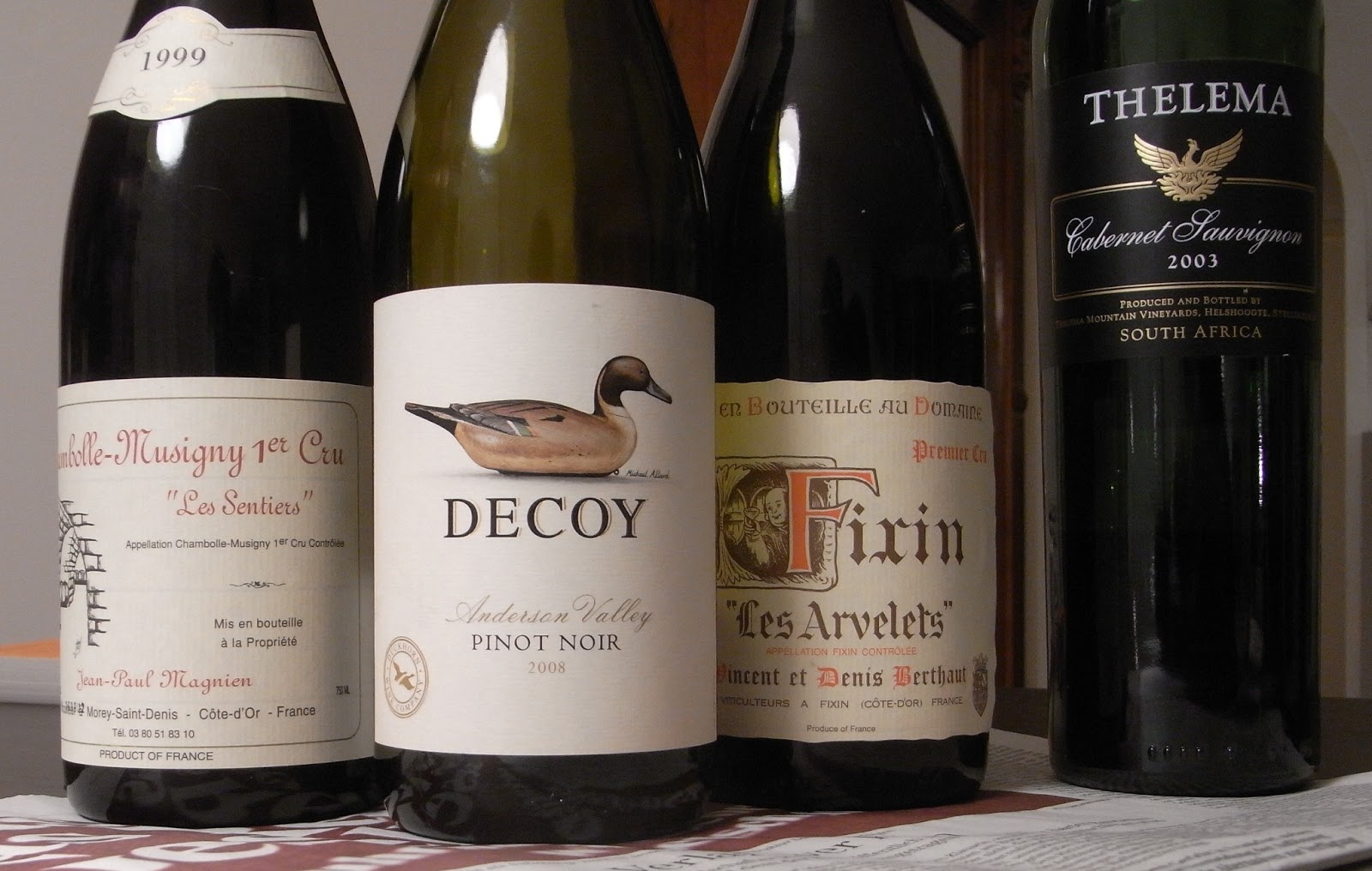
Duckhorn Vineyards Decoy Pinot Noir 2008, Anderson Valley + Three
Today I get back to my wine drinking roots! One of
the first mentionable and expensive wines I had was a Duckhorn
Vineyards Cabernet Sauvignon 1997 from Napa. Then, it was a really
wine "hooking"! I have no idea how the Cabernet Sauvignons
from Duckhorn do nowadays As far as I know they still have a very
renowned name in the Napa business. Anyway, today's wine is a product
of a Duckhorn branch called Decoy in Anderson Valley AVA. The most
northern AVA in California. This Pinot is the little brother to the
by far better known and much more expensive Goldeneye Pinot Noir.
Some years ago I had the opportunity to taste this Goldeneye. A once
in a lifetime Pinot Noir experience I would not like to miss for all
the wine in the world. Not because it was so fantastic or remarkable.
Certainly not! More because it was so extreme. It had not a lot to do
with features of Pinot Noir I so much adore. Maybe it was the best
caricature of high-quality Pinot Noir I ever had. A pure poster-boy
of Californian Pinot Noir as one might expect it to be. But that was
then and a very different Pinot. Let's see how the little brother was
doing.
Besides the Decoy there were some additional Pinots from Burgundy and a Stellenbosch guy for dessert!
16.10.12
Crystallum Wines Peter Max Pinot Noir 2008, Western Cape
In the past week I tried some Pinot stuff from the alleged rising star of Walker Bay. In 2007 Andrew and Peter-Allan Finlayson (the sons of the famous Peter Finlayson) started their Crystallum Wines project in Hemel-en-Aarde Valley. My wine was the entry level Pinot Noir “Peter Max”. Peter and Max are the given names of the growers who supplied the fruit for the first vintage (my 2008 vintage) of this wine. So much for explanation of this curious name. The grapes for the Peter Max 2008 were cultivated in two different cooler climate appellations: Walker Bay and Elgin. The aging (approx. 11 months) took place in mostly used oak barrels (just 25% new ones). The result of the first vintage were 5500 bottles of decently produced Pinot.
1.10.12
Lil' Corton-Charlemange? Paul Cluver Estate Chardonnay 2010, Elgin and a Wild Assortment of Some Other Chardonnays
On various
occasions I’ve seen a concise description of this Chardonnay which always ended with the
conclusion: “tastes like a little Corton-Charlemange”! Can that be true? If so, how? I
anticipate a bit: No! At least not for me! I don't even know how to relocate this Chardonnay to Burgundy? The characteristics of this wine weren't all too "Burgundian-Style" (whatever that might mean). At least to me. I also don’t know what these references or insinuations might mean! Are
there precise and typical characteristics to all Corton-Charlemagne wines? As far as I am concerned:
not so much (perhaps anymore? If ever?)! Does that implicate high standard quality? And what the hell does “little” mean anyway? Sorry for those rude questions to an invisible addressee! I am just a bit peeved about these ongoing and totally useless marketing delusions! I can’t see any need
for such comparisons! I anticipate again: It is a good wine with a certain amount of “unique” characteristics!
There is no need for such marketing driven verbalisations! Guys, let the
quality speak for itself! Considering its attractive price, accessibility and international ratings (for me a bit too high ones) there won’t
be any problem in selling this Chardonnay! Sorry, enough bewildering bashing for today ;-)! Now
the wine:
31.8.12
Rare Pinotage Expirience: Springfontein Pinotage Terroir Selection 2007, Walker Bay and a Grenade?
This time I
got a wild mix of three very different wines for you. I suppose it wasn’t the best idea to have them
at the same time ;-). Whatever, at least it wasn't intentional! More a bit later ...
It was a cold climate Pinotage from Walker Bay, the Trentino Classic named "Granato" from Elisabetta Foradori and another classic, this time from Stellenbosch, the Thelema Mountain Vineyards Cabernet Sauvignon.
7.4.12
Bio-dynamic Red'ster from False Bay: Reyneke Cornerstone 2008, Stellenbosch
Today’s wine is a red blend made of Cabernet Sauvignon (50%), Syrah (40%) and Merlot (10%) from a biodynamic winegrower and producer in Stellenbosch. Mostly known for its various and very unique Sauvignon Blanc wines, Reyneke gained quite some reputation over recent years. Today’s red blend was pretty unique and somehow full of character. So let’s get on with it …
20.3.12
Quick Chardonnay Interlude: Amani Vineyards Chardonnay 2007, Stellenbosch
Unfortunately I don’t know much about today’s winery. It is relatively young (est. 1997), it is situated in the Polkadraai Hills in Stellenbosch, the winemaker is a very energetic young woman named Carmen Stevens and it seems to be very much in favour of John Platter wine guide in recent years. The vines for this Chardonnay were 10 to 11 years old, grown on klapmuts and fernwood soil, the fermentation was 50% spontanious and the rest inoculated with a pre-selected yeast culture and finally the juice was aged for 10 months in 19.6% new French Oak. UUUUhhh!
Judged from the colour of this wine - it seemed pretty well aged. Pretty strawy golden yellow reflexes with hardly any particles. The nose was rather flinty, got a lot of aged lemon, some petrol and not a lot of typical oak scents. Same impressions from the taste! Here the lemon flavours reminded me of lemon-flavoured-whipped-cream which was supplemented with plenty of egg white and maybe some traces of egg shells. I couldn't spot any obvious difficulties or even faults. Nice, easy drinking, New-World (but not too New World ;-) ), semi bodied, classy Chardonnay for less than 10 Euros. No Problems at all!
15.3.12
Fizz from Good Old Constantia: Steenberg Brut 1682 Chardonnay 2009, Constantia
Today I got some fizz from one of the oldest “New World” wineries for you: Steenberg in Constantia Western Cape. It is a weathered granite cultivated 100% Chardonnay sparkling from a winery which was founded in the late 17th century in the Steenberg Mountains (Mountain of Stone) by Catharina Ras a native Lübeckanese. Today, Steenberg is a national and international well renowned mid-size winery famous for its Sauvignon Blanc and sparkling wines, as well as a culinary and hotel business highlight of RSA.
23.2.12
Nkosi Sikelel' iAfrika: Springfield Estate Chardonnay Méthode Ancienne 2006, Robertson
This time the actual wine ought to remain in the absolute centre of attention! Not so much winery talk or whatsoever. OK, let me anticipate a bit. A fantastic and simply unique wine (for RSA)! The Méthode Ancienne Chardonnay 2006 was produced by Robertson’s flagship winery Springfield Estate. I’ve got to admit: Not big adventure wine, nothing hyper curious, but profoundly impressive. Harvested from 25 year old vines (Clone CY3), fermented for more than 50 days with native yeasts, aged for 12 months in 300 l oak barrels (50% new, 50% used Allier) and the 3 Us: unfiltered, unfined and unstabilized. So much for the classic wine marketing babble nobody wants to read. Now wine!
20.2.12
GOC: Bouwland Cabernet Sauvignon Merlot 2007, Stellenbosch
Definitely no discovery! Definitely not astounding! Definitely not overwhelming! But still noteworthy and in its own way - beautiful! But not too elaborate or excessive wine blather, pls.! And without further exclamation marks. Promise ! (Arrggh, agaain ...)
14.12.11
A Medoc from Stellenbosch: Kallista 2004, Vriesenhof, Stellenbosch + some original friends
Isn’t it nice to have a couple of comparable wines next to each other waiting in line to enter your gullet? Of course it is! This time I had a very interessting tasting with several Bordeaux'ish red blends. Why Bordeaux'ish? Well because the most classical Medoc (for me) came from Stellenbosch. Let's start with this one.
The Kallista 2004 was a “true” Medoc from Stellenbosch. Very continental and classical style. Extremely surprising! In a blind tasting you might get deceived by the austere, straight, forward, pretty powerful, gentle and down-to-earth style of this red blend. A well known feature of the Vriesenhof wines in general. This Blend was composed of 37% Merlot, 36% Cabernet Sauvignon and 27% Cabernet Franc. My first impression was: rather hard and classic style, hyper dry, not all too fruitful, maybe a bit clumsy, still rather hard tannins and stronger acid, plenty of chocolate, dark rubber, some animalistic components, slightly stinky fragrances and still pretty juvenile. After a while impressive cold and dark cherry flavours, as well as quite a lot of red paprika powder flavours, developed. A gentle and rather fresh acid remained. The wild animal components faded a bit, but never vanished completely. A certain amount of black pepper, and aromas of wild spices joint the reclined party in my mouth. The impressive power and elegance remained throughout the whole evening and the next day. Very convincing wine with a fantastic QPR. I really don’t want to compare the styles of the consumed wines. In my personal and utterly subjective opinion this wine was by far more Medoc than the other ones. Maybe with the exception of the Langoa-Barton 2001. This one was very St. Julien, agian in my utterly subjective opinion ...
Chateau Langoa Barton 2001, St. Julien
My first impression of the Langoa-Barton 2001 was very silky and a light combination of typical Medoc wine flavours. Quite a lot of spice, black pepper, a bit tar, a slight hint of eucalyptus, a bit too much steel, a lot of pencil, somehow impetuous, not so power-gentle and surely elegant like many St. Julien wines. Later far more contenting flavours of milky-bitter-cherries, pepper, coffee, a hint of bitter choco and undergrowth developed. After some hours and on the next day a more typical elegance and arrogance took the lead. Just the way I like my Juliens. Nice treat, but 2001 wasn’t a super vintage for sure. A little bit more force and power would have been better ;-)
At first, the Sociando appeared far more accessible, silkier, rounder and maybe a more “sweet” than the others. I got flavours of chocolate, cappuccino, dark berries, ketchup, a hint of cola and a bold variety of warm indescribable feelings. Its style was straight, a bit warm, cosy, mildly elegant, with a certain freshness and almost quaffable. Later more rigid and butch flavours like white and black pepper combined with wilder spicy components evolved. Impressive Medoc expirience without a lot of potential to improve. Drink up, I say!
Chateau Tour de Pez 2010 (barrel sample), St. Estephe
This Tour de Pez 2010 I was a barrel sample I “snitched” from a wine merchant. It is always a nice opportunity to overlook the development of a young wine for several days. My first impression was purple soup! Great! I got loads of caramel, liquorice, rubber, cassis, smoke, fart, intensive fruit and juvenile sweetness in my nose and on my palate. Very fleshy and forceful stage at this moment. Surprisingly not as harsh and hard as I would have expected this wine at the moment. The tannins or acid were rather tame and peaceful. Already pretty accessible, but not as a Bordeaux. More like a powerful / juvenile Grenache based wine from the Rhone region. On the third day the distressing features faded and a decent young Bordeaux appeared. I see a lot of potential for this one. According to that impression 2010 will be a fantastic vintage. Again …. Beware very high headache potential!
6.12.11
Last summer I had a couple of very enjoyble Pinots from Africa, Aotearoa and California
Bouchard-Finlayson Galpine Peak Pinot Noir 2004, Walker Bay
Is this really Pinot Noir? Really? Well, at least it is a product from a coop between Bouchard Pere et Fils and Peter Finlayson - the former winemaker for Hamilton-Russel in Walker Bay. This Pinot wasn't even close to the attributes I interlink with Ham Rus Pinots. At first it gave me a lot of distress. It was wild, a bit aggressive, showed plenty of alcohol and was very much dominated by aromas of dried fruits. The first two hours I'd guess it could be an Amarone or something like that. After that period, a typical Sangiovese cherry flavour tendency developed. Very strange! On the second day it wasn't that aggressive anymore. Even some gentleness developed. Unfortunately there was still not a lot of acid present. This one might have provided the wine a better balance. The high amount of extract and concentration was definitely a plus, but if you are expecting a "normal - (and due to the price a high class)" Pinot you might get disappointed. The QPR is astoundingly miserable (approx. 30 Euros, today more something like 40 Euros).
Te Kairanga Runholder Pinot Noir 2005, Martinborough
For those who don't know. Martinborough is situated east of lake Wairarapa on the North Island of Aotearoa. The Runholder is Te Kairanga's basic Pinot. At first I got plenty of raspberries. Some hours later quite a lot of cherries and plums, too. A bit rustic maybe. Even some barn and cow flavours. Very nice acid (almost a bit too much) and plenty of semi-bodied strength. Clear aromas and some freshness resp. life were present as well. It might have reminded me of a stronger and more concentrated Pinot from Maconnais region. Or maybe a Rully? I guess, right now is a very good time for consumption. I am sure it'll last another year or so. The price is okay but not too great (approx. 20 Euros).
Belle Glos Winery Clarke & Telephone Vineyard 2005, Santa Maria Valley
Damn! This is something! A rather subtle example of an Central Coast Pinot. Apparently the Clark & Telephone Vineyard is one of the oldest Pinot cultivation areas in the AVA Santa Maria Valley (est. 1972). At first I got beautiful as well as powerful clear Pinot aromas. Plenty of juciy cherries, some oak, a hint of raspberries and almonds. It was charming, beguiling and almost aristocratic (in its particular own way of course). Its marmelade punch tendencies weren't too distinct. At the same time it appeared to have quiet a lot of spicy and rather fleshy flavours supplemented by some serious flavours of cinnamon. Very nice surprise for little money. At least for a Californian Pinot. (apporx. 30 Euros).
Subscribe to:
Posts (Atom)