Showing posts with label Cabernet Sauvignon. Show all posts

1.9.16

Wild vermischtes Kalifornien der ausgedehnten 90er


Im gerade eben erst ausgelaufenen August habe ich einige pinot-ferne kalifornische Rotweine älteren Jahrgangs getrunken. Drei aus den 1990ern und einer der gerade so über die Milleniumsgrenze gesprungen ist. Also ein 2000er. Darunter waren solche Klassiker wie Caymus Cabernet Sauvignon und einen Ridge Santa Cruz Mountains Cabernet Sauvignon. Aber auch sehr ausgefallenen Kreationen wie ein Super Tuscan aus Napa oder einen mittlerweile fast schon autochton anmutenden Wein von Ridge. Die etwas längere Zeit haben alle gut überstanden. Und so waren sie dann schließlich ...

23.4.15

Moser Family Cabernet Sauvignon Changyu Winery 2010, Ningxia


你们好 und ein zünftiges SERVUS der sich fortschreitend konzentrierenden Leserschaft dieses Weinblogs ;-)! Endlich geht es mal wieder um Wein der nicht alle Tage auf mitteleuropäischen Mittagstischen zu entdecken ist. Nun ja, letzteres dürfte sich doch auf mehrere vorgestellte Weine dieses Blog's beziehen. Aber genug der Faselei! 
 
Bei meinem heutigen Wein handelt es sich um einen chinesischen Österreicher oder einen österreichischen Chinesen oder einen Volksrepublikanischen Homo austriacus oder einfach nur um Cabernet Sauvignon aus der Provinz Ningxia der unter der Mitarbeit von Lenz Moser, einem nicht ganz unbekannten Weinhändler und Produzenten, in einem Chateau von China's traditionsreicher Changyu Winery entstanden ist. Gegründet wurde Changyu in Yantai schon vor mehr als 100 Jahren. Doch erst seit gut 20 Jahren im Zuge der Öffnung der chinesischen Wirtschaft expandiert das mittlerweile gigantische Unternehmen in die unterschiedlichsten Landesteile des Reichs der Mitte (aktueller Stand sechs Chateaus – was wörtlich zu nehmen ist - in unterschiedlichen Provinzen). Die Trauben für den Moser Family Cabernet Sauvignon 2010, den man getrost als einen Zweitwein des Hauses bezeichnen könnte, stammen aus der weinbezogen sehr aufstrebenden zentral-chinesischen Provinz Ningxia. Das eigentliche Weingut Changyu Moser XV wird nach der Ningxia Klassifikation (angeleht an die  1855er Klassifizierung), ja die gibt es seit dem Frühjahr 2014 wirklich, als eines von zehn 5th Growth Weingütern gelistet. Seit eingen Jahren werden auf ca. 75 Hektaren werden in einer Höhe von 1100 Metern über dem Meeresspiegel Cabernet Sauvignon und Merlot Trauben nach ECOCERT Richtlinien angebaut. Na dann lasst uns doch mal schauen wie er denn nun war ...


2.9.13

And Now for Something Completely Different ... A Lil' Natureo Tasting


Bored people are into astoundingly questionable actions! Today, I would like to indulge myself with something completely different! For the sake of conciseness I'll try to stick to the basics concerning the producer, to the production process and to the actual “wines”! I hope my plan will work out! Not quite sure yet …

Well, there is not too much to elaborate about the producer: Just Torres! The big Catalan wine empire which was founded in the second half of the 19th century which stretches out all over Spain, California and Chile. Famous names like Mas la Plana, Coronas and Marimar Estate speak for themselves. Natureo, a relatively young project, might be not that overwhelmingly famous! What is it? Well, wine – which was de-alcoholised to a level just below 0,5% of alcohol! Yeah – sounds a bit grim, right? Today's both “wines” were fermented for two weeks in stainless steel at a permanent temperature between 14 to 16 centigrade + a bit of skin contact time for the redster and subsequently de-alcoholised. That's enough techno-knowledge for today! Let's keep the concise manner, no more jabbering and straight over to the „wines“ …

13.8.13

Castel Schwanburg Südtiroler Cabernet 1989 und zwei Blaulemfränkberger


Es ist manchmal schon verwunderlich was sich so alles in Weinhandlungen finden lässt. Erst letztens bin ich über ein paar in Originalfolie verpacke Flaschen aus der Prä-Mauerfall-Ära gestolpert, die sich äußerlich in einem fantastischen Zustand befanden. Wenn diese besagten Weine nun aus einem der klassischen Weinbaugebiete der großen Bs, Rs oder Ms gewesen wären würde ich mich nicht so wundern, dass ich mich hier auto-genötigt fühle darüber schreiben zu müssen. Doch es war kein Wein aus den berühmten alterungsfähigen Fabellagen der Weinwelt. Mein heutiger Wein stammt aus dem kleinen Südtirol und war noch so erschreckend gut in Schuss, dass ich doch sehr überrascht war …

12.2.13

Cab von hier und da, aber das Allerbeste war das Trallala


Letzte Woche war ich mal wieder privilegiert genug etwas Wein schnorren zu dürfen. Noch nicht unter einer Neckarbrücke aus der Literflasche! Aber das mag wohl auch noch kommen. Mal sehen was die Zukunft so parat hält ;-)! Dieses Mal gab es einen vielschichtigen und auskunftsfreudigen Riesling aus der Pfalz, einen wunderbar „antiquiert“ schmeckenden Bordeaux und einen Cabernet Sauvignon aus Kalifornien auf den ich besser nicht sonderlich ausgeprägt eingehen sollte.


26.1.13

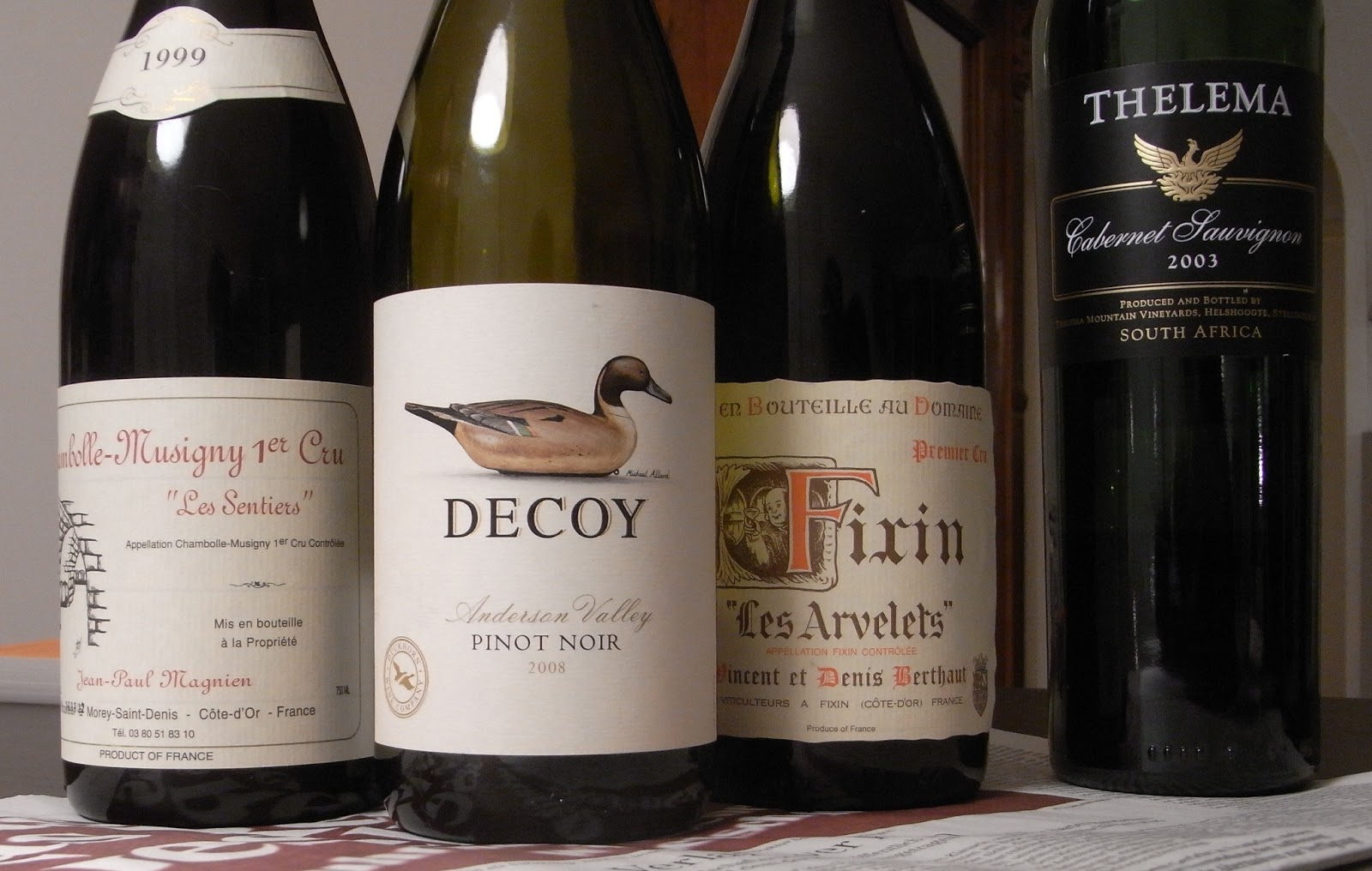
Duckhorn Vineyards Decoy Pinot Noir 2008, Anderson Valley + Three


Today I get back to my wine drinking roots! One of the first mentionable and expensive wines I had was a Duckhorn Vineyards Cabernet Sauvignon 1997 from Napa. Then, it was a really wine "hooking"! I have no idea how the Cabernet Sauvignons from Duckhorn do nowadays As far as I know they still have a very renowned name in the Napa business. Anyway, today's wine is a product of a Duckhorn branch called Decoy in Anderson Valley AVA. The most northern AVA in California. This Pinot is the little brother to the by far better known and much more expensive Goldeneye Pinot Noir. Some years ago I had the opportunity to taste this Goldeneye. A once in a lifetime Pinot Noir experience I would not like to miss for all the wine in the world. Not because it was so fantastic or remarkable. Certainly not! More because it was so extreme. It had not a lot to do with features of Pinot Noir I so much adore. Maybe it was the best caricature of high-quality Pinot Noir I ever had. A pure poster-boy of Californian Pinot Noir as one might expect it to be. But that was then and a very different Pinot. Let's see how the little brother was doing. 

Besides the Decoy there were some additional Pinots from Burgundy and a Stellenbosch guy for dessert!


28.10.12

Time for the Best Sport Ever: Jim Barry The Cover Drive Cabernet Sauvignon 2007, South Australia

Wine and a cricket match! What else could be better? Well, I don’t know! Probably a couple of things!? Cricket, of course is beyond reproach. However this combination might not be this compelling. But first some info: The vines for this Cabernet Sauvignon were planted on a former Cricket Pitch in Coonawarra, in the shape of the pitch, on the most southern corner of South Australia. The soils are the famous Coonawarra "terra rossa" and limestone.


31.8.12

Rare Pinotage Expirience: Springfontein Pinotage Terroir Selection 2007, Walker Bay and a Grenade?


This time I got a wild mix of three very different wines for you. I suppose it wasn’t the best idea to have them at the same time ;-). Whatever, at least it wasn't intentional! More a bit later ...
It was a cold climate Pinotage from Walker Bay, the Trentino Classic named "Granato" from Elisabetta Foradori and another classic, this time from Stellenbosch, the Thelema Mountain Vineyards Cabernet Sauvignon.


7.7.12

Royal Aged Cabernet from the East: Zar Simeon Cabernet Sauvignon Premium Reserva 1999, Nova Zagora

Forged from 30 years old Cabernet Sauvignon vines this Bulgarian Tsar impressed with tonnes of strength, tannin and Rioja-Style-American-Oak-Flavours (12 months in 100% new barrels). The Premium Reserva is the flagship of the Zar Simeon Winery and one of the most expensive wines in all of Bulgaria. The winery itself was the most renowned pioneer for quality winemaking in Bulgaria since the collapse of the Soviet Union. How come the Bulgarians have a relatively large amount of experience and know-how with Cabernet Sauvignon? Even during the communist era. I could not find a satisfactory answer! Maybe you guys got an explanation? But now, the wine: 


16.6.12

Bharat Cab and the Sociandos: Four Seasons Ritu Barrique Reserve Cabernet Sauvignon 2008, Maharashtra


Salaam Maharashtra once again! This time with Cabernet Sauvignon from Four Seasons Winery, a project of the Bouvet-Ladubay Empire and the actual Indian owner of B-L, in Pune District. Besides the Maharati Cabernet I had a triumvirate of Sociando–Mallet wines from three different decades.  


13.6.12

Langmeil Winery Blacksmith Cabernet Sauvignon, Barossa Valley SA

Today I just make a very quick Pit-Stop with a Cabernet Sauvignon from Barossa Valley and a wine from Pfalz region in Germany made of a relativly scarce varietal. But first things first! Langmeil in Barossa is rather famous for its Shiraz wines. Allegedly they own the oldest Syrah vines (from the mid 18th century) on the planet. Well, whatever today's wine is a Cabernet Sauvignon which was aged in primarily "seasoned (indicated on the back label)" French oak (ratio 20/80) for 24 months.


24.11.11

Something new from a historical landmark: Massandra Cabernet Sauvignon N.V.

My third new post and already a tasting note from a guest! OK, I am not that lazy. I just need some turnover after such a long and dry blabbing phase.

First some interesting facts about Massandra: Apparently Massandra is the oldest and most renowned winery in nowadays Ukraine. It is situated near Yalta on Crimea Island. By the influence of Prince Lev Golitzin, an accomplished winemaker, the winery soared to new and unknown qualities. Their wines were popular and highly demanded all over Eastern Europe and the Russian Royal Family. Then and now the most interesting and demanded wines are the Muscat dessert wines produced from varietals like White Muscat, Surozh Kokur, Rosé Muscat, Black Muscat, Pinot Gris, Bastardo, Ayu-Dag Aleatico, Cagors and Ay-Serez (most I never heard of), as well as their liqueur wines made from the same and some more varietals. The most interesting fact about this winery might be their enormously big cellars with huge amounts of very old vintages. Unfortunately no place for bargains anymore. After the fall of the iron curtain the prices increased drastically. I have been told that the style of their desert wines show resemblances to good Tokaij wines. I guess it is up to everybody personal taste whether to decide this resemblance as justified or not. I have no clue.

The following wine has absolutely nothing to do with dessert wines. It is a non vintage Cabernet Sauvignon. The alcohol was between 10 -13 % (very strange indication) and it was bottled in August 2011. Now we have a short guest tasting note by Marcus Deus:

The colour isn’t all too dark. In the nose there are fruitful as well as earthy austere scents. The tannins are rather present and still hard. Plenty of acid. A very nice and decent fruit potpourri. Shows clear resemblances to a light Cabernet Sauvignon wine. Some hints of mineral features, too. 82P

Approx. two years ago I had the same Cabernet. My impression was almost the same. Back then, I was under the impression that the grapes might have suffered under great heat. I tasted loads of raisin flavours. I guess it was a nice and drinkable wine, but nothing more.

The other Massandra wine I had some time ago was far more interesting. Went down very well. Alongside with some rather pleasing and rustic Ukrainian caviar (see photo on the right). Pretty strange combination. I am totally aware of that ;-).

14.4.08

Mexico: Traditional wines from the new world? Casa Madero Cabernet Sauvignon 2002

At the beginning I was quite pleased to see a very dense stinging dark red in my glass. The rim was slightly brown. The nose had a lot of power. Mainly paprika and dark pepper fragrances as well as some smoke and burned nuts. So far it was a rather nice and admitingly surprising experience. Unfortunately the taste swept the positive expression away. Astringent and crude acid, unpleasent bitterness, some petrol flavours and a weird impression of wet cellulose put my previous statement about the fragrance into perspective. Of course I could spot pepper and vanilla aromas as well, but these artificial flavours of cellulose (or somthing like that) destroyed my enjoyment. Two days later I've tried it again, but the disturbing aromas remained. Only some eucalyptus aromas, like Cabernet Sauvignons from Chile, developed a little bit. Maybe my bottle wasn't all right and I just got a wrong impression.